Glowworms Are Not Worms, And Five Other Things People Get Wrong
It is a fly larva. The light is bait. Hungry ones glow brighter. Adults cannot eat. Six corrections to the things almost everyone believes before they walk into the cave.
 Written with Hemi Williams, Waitomo cave guide and local specialist, guiding since 2015
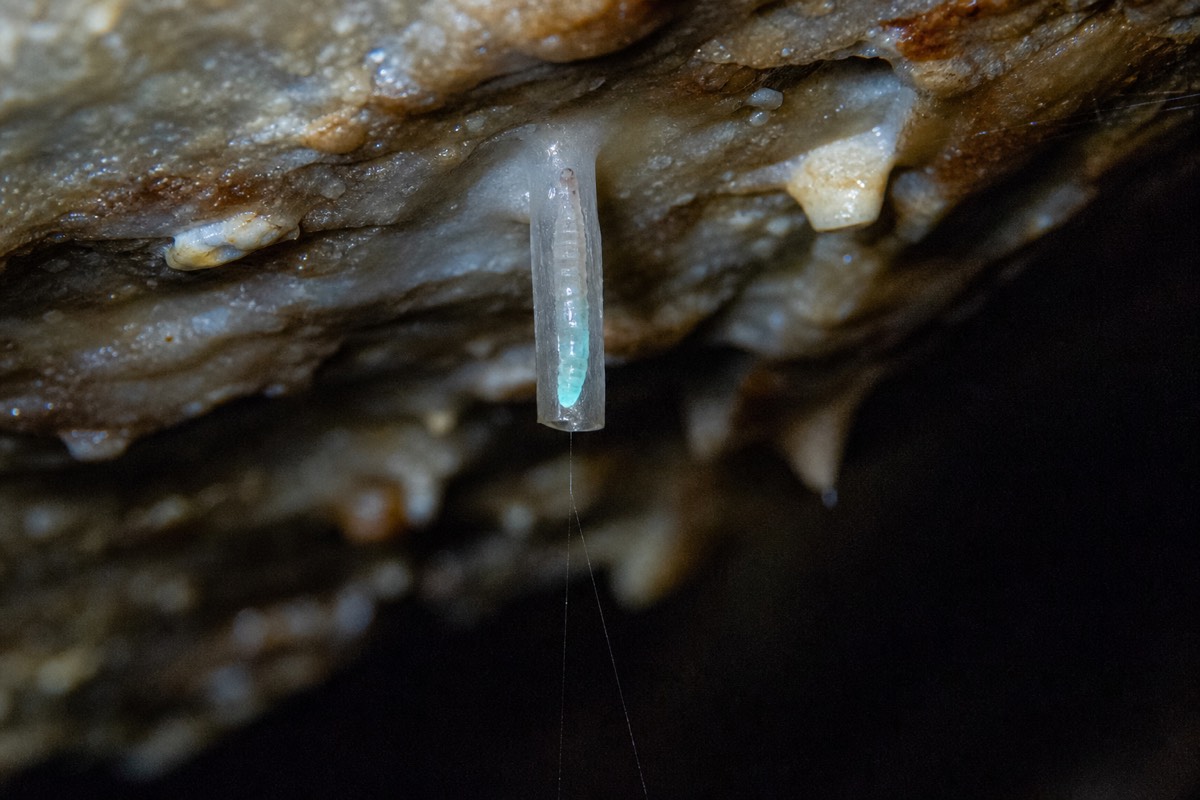
The name has done a lot of damage. Say glowworm and people picture something soft and segmented, glowing gently, minding its own business. What is actually up there is a predator in a mucus tube, hanging sticky lines into the dark and using its own body as a lure, and it will eat its neighbour if the neighbour gets too close.
Is A Glowworm A Worm?
No. It is the larva of a fungus gnat, Arachnocampa luminosa, and the stage you see in caves lasts 6 to 12 months of a life cycle that ends in a small fly. It grows from 3 to 5 millimetres at hatching to 30 or 40 millimetres at full size, all of it spent hanging on a ceiling.
The species record sets out the biology, and Zealandia, the sanctuary that studies them above ground, uses the Māori name tītīwai for them. The English name is a description of what it looks like, not of what it is.
| The belief | The correction |
|---|---|
| It is a worm | It is a fly larva |
| It glows to be pretty | It glows to bait a trap |
| Well-fed ones glow brightest | Hungry ones do |
| It lives a long time as a glowing adult | The adult lives days and cannot eat |
| It is the same as a firefly | Different animal, different chemistry, different purpose |
| They are found all over the world | This species is endemic to New Zealand |
What Is The Light For?
Fishing. The larva hangs up to about 30 silk lines below itself, some as long as 50 centimetres, beaded with sticky droplets. It lights its tail end, insects fly toward the light, and they stick. The larva hauls the line in and eats.
This is why hungrier larvae glow more brightly, which is the fact that reliably surprises people. The glow is not a state of contentment, it is an advertisement, and an animal that has not eaten advertises harder.
It helps explain the emphasis on keeping the cave dark and undisturbed. Competing light makes the trap useless, disturbance makes larvae dim defensively, and the colony is the entire commercial basis of the site. That is why photography is prohibited and why the guide asks for silence on the boat.
The name is the source of most of the confusion, and it misleads in three directions at once.
| The name suggests | The animal actually is |
|---|---|
| A worm | The larva of a fly |
| Something that glows passively | A predator using light as bait |
| A creature you could keep | Territorial, cannibalistic, and dead within days of maturing |
Is It The Same As A Firefly?
Not remotely, beyond both making light biologically. A firefly is an adult beetle signalling to attract a mate, glowing yellow-green. A New Zealand glowworm is a fly larva baiting a trap, glowing blue-green at around 480 nanometres.
The chemistry differs too. Work published in Scientific Reports in 2018 showed that while both use a luciferase enzyme, the glowworm's luciferin is a chemically different molecule, built from xanthurenic acid and tyrosine. Two animals arrived at bioluminescence separately and did it with different ingredients.

What Happens When It Stops Being A Larva?
It becomes a fly with no working mouth and about three days to live. After a pupal stage of twelve or thirteen days, the adult emerges, mates, lays eggs and dies. Females survive up to around 76 hours, males up to around 96. Neither can eat.
That is the whole point of the long larval stage. Everything the animal will ever consume, it consumes hanging on that ceiling over the course of most of a year. The adult stage is a reproductive appendix to it.
Which means the display you look at from the boat is not a colony of adults being beautiful. It is several thousand juveniles in the middle of the only feeding period they get, and the light is the mechanism.
Do They Glow All Year?
Glowworms can be seen throughout the year. This is a natural display, so brightness and what you see can vary. A cave setting does not make the tour independent of weather or operating conditions.
When choosing when to visit, consider your itinerary and the departures offered for your date. The experience is weather-dependent, so review rain and bad-weather planning rather than assuming every wet day is unaffected.
Where you can see the species, and what each setting gives you.
| Setting | Density | Access |
|---|---|---|
| The Glowworm Grotto, Waitomo | Ceiling display | By boat, on the 45-minute tour |
| Ruakuri Cave | High, on foot | 90-minute tour, photography allowed |
| Ruakuri Bush Walk at night | Scattered | Free, unguided |
| Damp bush banks, both islands | Sparse | Wherever it is dark and wet |
Can You Touch Them, Or Take One Home?
No to both, and the second one is not a joke people have not tried. The silk lines are sticky enough for a midge and nothing larger. What damages a larva is contact with it or its mucus tube, both of which are fragile, along with light, noise and vibration.
They are also territorial. Larvae space themselves along a ceiling and a crowded patch produces cannibalism, which is why a colony looks evenly scattered rather than clustered. That even spacing is not decorative, it is a negotiated grid of hunting stations.
The species is endemic to New Zealand, which is a large part of why the caves at Waitomo became an international attraction rather than a local curiosity. The full biology guide covers the life cycle in more depth.
Where Can You Actually Watch One Closely?
Not on the flagship tour, which is the irony of the most famous glowworm attraction in the country. The Grotto is a ceiling seen from a moving boat in the dark; you see the effect rather than the animal.
| Where | How close you get |
|---|---|
| The Glowworm Grotto, by boat | The overall display; no individual detail |
| Ruakuri, on foot | Close enough to see individual larvae and their lines |
| A small-group cave tour | Viewing and photography depend on the route and operator |
| The Ruakuri Bush Walk at night | Very close on the bank; entirely at your own pace |
| With a torch directed at the colony | Artificial light can interfere with viewing; follow the guide’s instructions |
If the biology is what interests you rather than the spectacle, book a walking cave rather than the boat. A walking format lets you focus on the cave and its glowworms on foot; the view and commentary vary by tour.
What Is The Silk Actually Made Of, And How Does It Work?
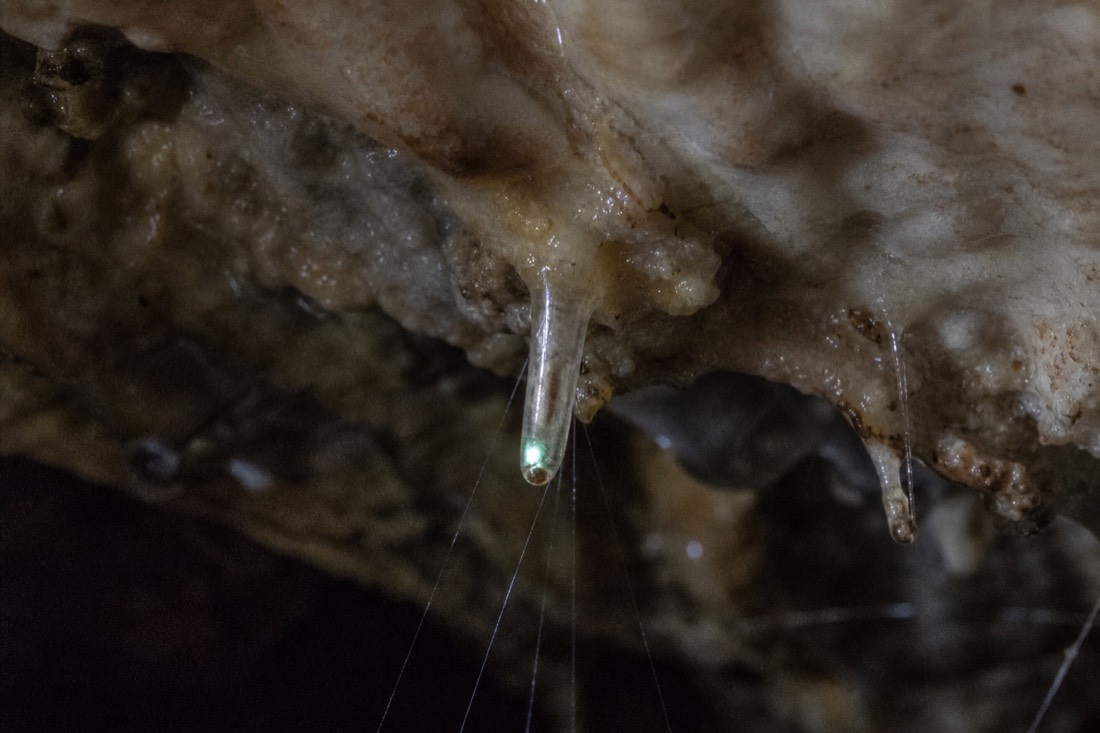
A sticky mucus thread, hung vertically, holding droplets like a fishing line with bait on it. Each larva can hang up to around thirty of them, between two and fifty centimetres long, from a horizontal mucous tube it lives inside.
| Component | Function |
|---|---|
| The mucous tube | The larva's home; it moves along inside it |
| The vertical lines | The trap, hung below the tube |
| The droplets | Adhesive, and what the prey sticks to |
| The light | Bait; insects orient towards it and fly up |
| Hauling in | The larva pulls the line up and eats the catch |
Air movement is the enemy of that arrangement, which is why glowworm colonies favour sheltered caves and overhangs and why a windy bush bank is a poor place to look. Tangled lines catch nothing, and a larva with tangled lines has to rebuild them.
What kind of animal is a New Zealand glowworm?
The larva of a fungus gnat, Arachnocampa luminosa. It spends 6 to 12 months hanging in a mucous tube on a cave ceiling, growing to 30 or 40 millimetres, before pupating and emerging as a small fly that lives a few days.
Why do hungry glowworms glow brighter?
Because the light is bait. The larva uses it to lure flying insects onto up to about 30 sticky silk lines hanging below it. A larva that has not eaten has more reason to advertise, so it glows harder. Brightness is not a guaranteed constant for a natural display.
Are glowworms and fireflies related?
Only distantly, and functionally not at all. A firefly is an adult beetle signalling to mate. A glowworm is a fly larva baiting a trap. Even the chemistry differs: the glowworm's luciferin is a different molecule from the firefly's, per work published in 2018.
How long does a glowworm live?
Most of a year as a larva, then 12 to 13 days as a pupa, then a few days as an adult fly that cannot feed. Females survive up to around 76 hours and males up to around 96. Eggs hatch after about three weeks.
Can you touch a glowworm?
You should not. The larva and its mucus tube are both fragile, and light, noise and vibration all disturb them. The sticky silk lines are designed to hold small flying insects, not to catch anything larger. Every rule inside the cave comes back to leaving them alone.
Choose Your Cave Date
Ready to see glowworms on foot? Check your Ruakuri date before fitting the 90-minute walk into your trip.
90-minute guided walk; allow two hours on site. English, glowworms on foot and photography permitted in designated areas, without tripods or extension sticks. Wheelchair/stroller access up to 65 cm wide; confirm individual needs. Own transport to Ruakuri.
Choose Your Cave
Would you rather observe glowworms on foot, photograph a rugged cave visit, or see the Grotto display by boat?
Tour duration excludes your travel and check-in. These are planning suggestions; confirm suitability and your chosen date with the provider.
- Ruakuri Guided Cave Walk
- 90-minute guided walk; allow two hours on site. English, glowworms on foot and photography permitted in designated areas, without tripods or extension sticks. Wheelchair/stroller access up to 65 cm wide; confirm individual needs. Own transport to Ruakuri.
- Off The Beaten Track Cave Tour
- Around 3.5 hours exploring a wild cave with a guide. Phones and small cameras allowed, no professional cameras or tripods. Uneven terrain; unsuitable for mobility, back or heart problems. Meet the operator locally. Minimum age 12, maximum weight 120 kg and moderate fitness required.
- Glowworm Cave Walk And Boat
- 45-minute guided walk and boat ride; allow extra time for check-in. English. Stairs, no wheelchair access and no photography. Meet at Waitomo; transport is not included.