What A New Zealand Glowworm Actually Is
Not a worm, not a firefly, and not the same chemistry. The larva of a fungus gnat that fishes with glowing silk, lives most of a year underground, and dies within days of growing wings.
 Written with Hemi Williams, Waitomo cave guide and local specialist, guiding since 2015
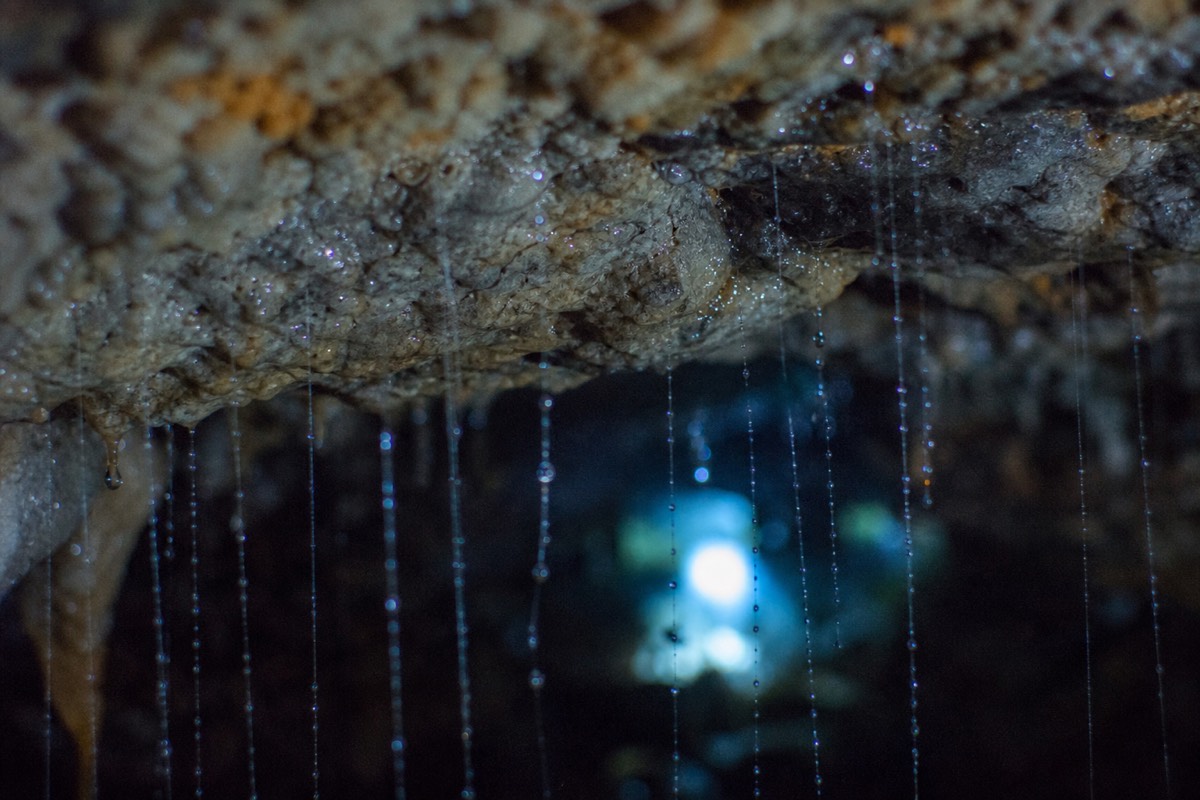
The name is wrong twice over. It does not glow the way a firefly glows, and it is not a worm. What is on the ceiling of the Grotto is the larval stage of a fly, hanging in a tube of its own mucus, fishing with lines of sticky silk, and lighting itself up because that is how it gets fed.
What Is A New Zealand Glowworm?
Arachnocampa luminosa, a species found only in New Zealand. It is the larva of a fungus gnat, and it spends 6 to 12 months in this stage, growing from 3 to 5 millimetres up to 30 or 40 millimetres. The blue-green light comes from its tail end, and it is used as bait.
The full life cycle is short at both ends and long in the middle. Eggs hatch after about three weeks. The larval stage, the one you see, lasts most of a year. Pupation takes around twelve or thirteen days. And then the adult fly emerges with no functioning mouthparts at all: it lives roughly three to four days, mates, lays eggs and dies without ever eating.
| Stage | Duration | What happens |
|---|---|---|
| Egg | About 3 weeks | Laid on the cave ceiling |
| Larva | 6 to 12 months | Fishes with silk lines, glows, grows to 30 to 40 mm |
| Pupa | 12 to 13 days | Hangs suspended, still glowing intermittently |
| Adult fly | Up to about 4 days | Cannot feed, mates, lays eggs, dies |
Almost everything you see in a New Zealand glowworm cave is the middle row of that table. The species is described in detail by Zealandia, the sanctuary that studies it above ground, where the Māori name tītīwai is also used.
How Does The Light Work?
Chemically, not the way a firefly does. Both animals use an enzyme called luciferase acting on a molecule called luciferin, but the luciferin is not the same compound. Work published in Scientific Reports in 2018 identified the New Zealand glowworm's luciferin as being built from xanthurenic acid and tyrosine, chemically distinct from the firefly's.
The output peaks around 480 nanometres, which is why the colour reads as blue-green rather than the warmer yellow of a firefly. In a cave with no other light source at all, that wavelength against black rock is what produces the effect people compare to a night sky.
| Feature | New Zealand glowworm | Firefly |
|---|---|---|
| Animal | Larva of a fungus gnat | Adult beetle |
| Light colour | Blue-green, around 480 nm | Yellow-green |
| Luciferin | From xanthurenic acid and tyrosine | Firefly luciferin, a different compound |
| Purpose of the light | Bait for prey | Mating signal |
| Where you see it | Cave ceilings and damp banks | Open air at dusk |
Why Do Hungry Glowworms Glow Brighter?
Because the light is a fishing lure, and a hungry larva has more reason to fish. This is the single most quotable fact about the species, and hunger can influence an individual’s light output. It does not establish that colony brightness is unaffected by season or other conditions.
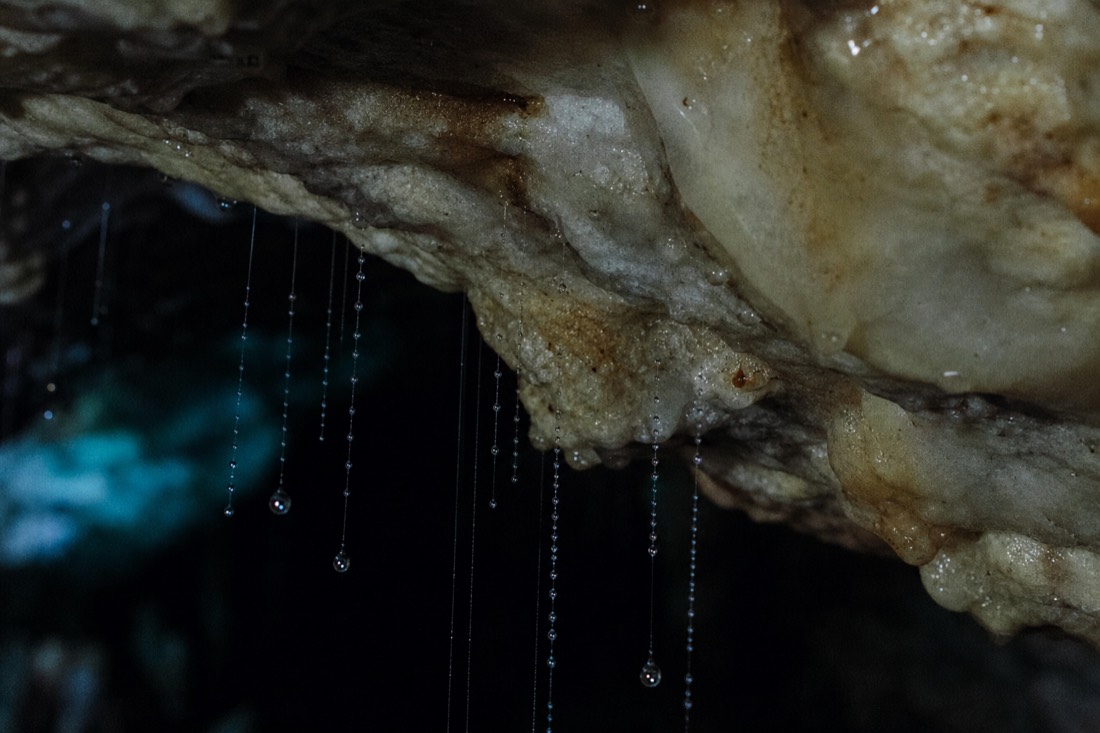
Each larva hangs up to about 30 silk lines, sometimes reported as many as 70, ranging from 2 to 50 centimetres long and beaded with droplets. Flying insects, many of which hatch from the stream below, are drawn upward toward the light and stick. The larva hauls the line in and eats.
That mechanism is why light and noise matter so much inside the cave. Light and physical disturbance can affect the animals. Follow the rule that photography is prohibited in the Glowworm Cave while Ruakuri permits it under its own visitor rules.

The three things visitors are asked to do underground all trace back to one piece of biology.
| Rule | What it protects | Why |
|---|---|---|
| No photography | The larva's hunting light | Larvae are sensitive to light |
| Silence on the boat | The larva's glow | Follow the guide’s quiet instructions |
| Do not reach up | The larva and its mucus tube | Both are fragile and easily destroyed |
Are They Dangerous, And Can You Touch Them?
Observe them without touching the larvae or their delicate threads. The silk lines are sticky enough to hold a midge, not a finger. What does damage is contact with the larva itself or its tube, both of which are fragile, and disturbance from light, noise or vibration.
They are also territorial. Larvae space themselves out along a ceiling, and a crowded patch will see cannibalism. That is one reason a colony looks evenly scattered rather than clumped: it is not decoration, it is a grid of hunting stations that have negotiated their distances.
The practical version for a visitor is short. Stay quiet on the boat, do not reach up, and follow the cave’s no-photography policy. All three requests come from the same place. What 45 minutes underground is really like covers how that plays out in practice.
Where Else Can You See Them?
Across both islands, in caves and on damp banks, wherever it is dark and wet enough.
But the species is not confined to show caves. The free Ruakuri Bush Walk, about 2 km from Waitomo village, has glowworms visible at night near the main bridge and costs nothing. The Te Anau caves in Fiordland hold a separate population in a cave system only about 12,000 years old, still actively being carved. The comparison between Waitomo and Te Anau covers what differs, and the country-wide survey covers everywhere else.
How Rare Is It To See One?
They can be found in suitable damp, sheltered habitats in New Zealand. Arachnocampa luminosa needs darkness, high humidity, shelter from wind and something flying below it to catch. Where these conditions line up, colonies can form a striking display. Suitable sheltered, damp habitat supports the colony.
That combination is ordinary in New Zealand and scarce almost everywhere else, because the species is endemic here. There are no wild populations to stumble across in Europe, North America or Asia.
| Condition | Why the larva needs it |
|---|---|
| Darkness for viewing | Makes the faint glow easier to see |
| High humidity | The silk lines and the mucous tube dry out otherwise |
| Shelter from air movement | Moving air tangles the fishing lines |
| Water or damp ground below | Flying insects hatch from it, and they are the food |
| Stable temperature | The cave holds 16 °C year round, which suits it |
A show cave is not a zoo enclosure. It is a place where those five conditions already held, and the management exists to stop visitors breaking them.
What Eats Them, And What Do They Eat?
Their sticky lines trap small invertebrates, and they also face predators and habitat disturbance. The lines catch midges, mayflies and small moths, most of which hatch from the water running below the colony. That is one link in the cave’s food web: prey becomes caught in the sticky snares.
Larvae are territorial and cannibalistic. A colony spaced evenly across a ceiling is not decorative, it is a negotiated grid of hunting stations, and a larva that drifts too close to a neighbour can end up as the neighbour's meal.
| Stage | What it eats |
|---|---|
| Larva | Flying insects caught on its silk lines; sometimes other larvae |
| Pupa | Nothing, it does not feed |
| Adult fly | Nothing at all, it has no working mouthparts |
The adult stage lasts up to around 76 hours for females and 96 for males. Everything the animal will ever consume, it consumes in the 6 to 12 months it spends hanging on that ceiling.
Why Does The Light Look Like That?
Because of where it sits on the spectrum, and because there is nothing else to compare it with. The glow peaks around 480 nanometres, in the blue-green, produced by a luciferase acting on a luciferin built from xanthurenic acid and tyrosine, which is chemically different from the compound a firefly uses.
Put a few thousand point sources of that colour on a black ceiling with no other light at all, and human vision does the rest. In near-total darkness the eye loses colour discrimination and depth cues, which is precisely why reviewers reach for the word galaxy: the brain is being handed the same visual input it gets from a night sky and reaching for the same interpretation.
| Property | Value | Why it matters |
|---|---|---|
| Peak wavelength | ~480 nm | Reads as blue-green, the colour of the effect |
| Light source | The larva's tail segment | Not the whole body, despite how it looks |
| Chemistry | Luciferase plus a novel luciferin | Independent of the firefly's system |
| Brightness driver | Hunger | Bait works better when the animal needs it to |
| Visible year round | Yes | Visible throughout the year; brightness varies |
Are They Related To Anything People Know?
To fungus gnats, which nobody has heard of, and distantly to mosquitoes and midges, which everybody has. Arachnocampa luminosa is a fly. The larva is the stage that glows, and the adult that eventually emerges is a small, short-lived, non-biting gnat.
| Common comparison | Accurate? |
|---|---|
| A worm | No. It is an insect larva |
| A firefly | No. Different order, different chemistry, different purpose |
| A caterpillar | No, though the body plan looks similar at a glance |
| A maggot | Closer than the others; both are fly larvae |
| A mosquito relative | Distantly, within the same broad group of flies |
The Māori name, tītīwai, is used alongside the scientific one and translates in a way that points at water, which is a better description of where they live than the English name is of what they are.
What Would Happen If A Cave Lost Its Glowworms?
Losing its glowworms would fundamentally change this attraction, which is one reason the cave environment is managed. The colony is not decoration added to a geological feature; it is the commercial and ecological centre of the site.
| Pressure | What it does | How the cave manages it |
|---|---|---|
| Light | Can affect glowworm behaviour | Total photography ban, controlled lighting |
| Noise and vibration | Follow quiet-viewing instructions | Silence requested on the boat |
| Carbon dioxide | Acidifies water films, degrades formations | Environmental monitoring |
| Humidity change | Silk lines and mucous tubes dry out | Continuous monitoring |
| Visitor volume | Drives all of the above | Managed visitor activity |
Read the rules in that light and the tour makes more sense. The things visitors find restrictive are the reasons there is still something to visit.
Is a New Zealand glowworm a worm?
No. It is the larva of a fungus gnat, Arachnocampa luminosa, and the stage you see in caves lasts 6 to 12 months. The adult that eventually emerges is a small fly that lives a few days and cannot feed at all.
Why do glowworms glow?
To catch food. The larva hangs up to about 30 sticky silk lines below itself and lights its tail end to lure flying insects onto them. Hungrier larvae glow more brightly, because a hungry larva has more reason to fish.
Are New Zealand glowworms the same as fireflies?
No. A firefly is an adult beetle signalling to mate, glowing yellow-green. A New Zealand glowworm is a fly larva baiting a trap, glowing blue-green around 480 nanometres, and using a luciferin that is chemically a different molecule from the firefly's.
Are they found outside New Zealand?
Arachnocampa luminosa is endemic to New Zealand. Related species in the same genus occur in Australia, but this particular one is found nowhere else, which is a large part of why the Waitomo caves became an attraction in the first place.
Do glowworms glow all year?
Glowworms can be viewed year-round. Hunger is one influence on individual brightness, but identical displays in every month or condition are not guaranteed.
Choose Your Cave Date
Have your cave experience in mind? Check your travel date before arranging the rest of your Waitomo day.
90-minute guided walk; allow two hours on site. English, glowworms on foot and photography permitted in designated areas, without tripods or extension sticks. Wheelchair/stroller access up to 65 cm wide; confirm individual needs. Own transport to Ruakuri.
Choose Your Cave
Would you rather observe glowworms on a guided walk, see the grotto by boat, or explore a natural cave actively?
Tour duration excludes your travel and check-in. These are planning suggestions; confirm suitability and your chosen date with the provider.
- Ruakuri Guided Cave Walk
- 90-minute guided walk; allow two hours on site. English, glowworms on foot and photography permitted in designated areas, without tripods or extension sticks. Wheelchair/stroller access up to 65 cm wide; confirm individual needs. Own transport to Ruakuri.
- Glowworm Cave Walk And Boat
- 45-minute guided walk and boat ride; allow extra time for check-in. English. Stairs, no wheelchair access and no photography. Meet at Waitomo; transport is not included.
- Off The Beaten Track Cave Tour
- Around 3.5 hours exploring a wild cave with a guide. Phones and small cameras allowed, no professional cameras or tripods. Uneven terrain; unsuitable for mobility, back or heart problems. Meet the operator locally. Minimum age 12, maximum weight 120 kg and moderate fitness required.