Where To See Glowworms In New Zealand
Show caves, free bush tracks and a lake crossing in Fiordland. Every realistic option ranked by what it costs, how long you get, and whether you can photograph it.
 Written with Hemi Williams, Waitomo cave guide and local specialist, guiding since 2015
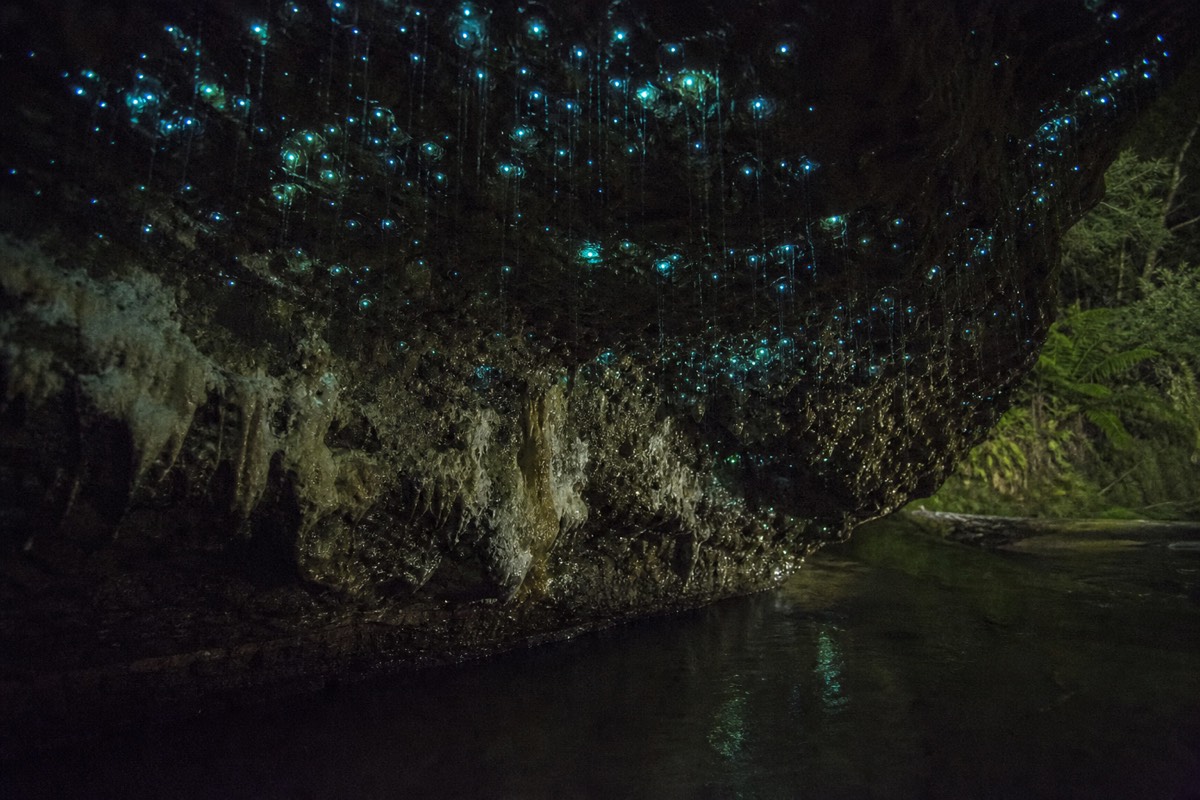
Ask where to see glowworms in New Zealand and you will be told Waitomo, which is correct and incomplete. The species turns up wherever it is dark, damp and sheltered, which in this country is a lot of places. Some of them cost NZ$145. Some of them cost nothing and are a fifteen-minute walk from a car park.
Where Is The Best Place To See Glowworms In New Zealand?
The Glowworm Grotto at Waitomo, if you mean the densest display and the most striking format. It is a chamber on the underground Waitomo River, reached by boat, and the concentration of larvae on its ceiling is what made the country's glowworms internationally famous. Everything else is a variation on the theme.
That said, "best" depends on what you are optimising for. Density, duration, price and photography pull in different directions, and no single site wins on all four.
| Site | Island | Format | Adult from (NZD) | Duration | Photography |
|---|---|---|---|---|---|
| Waitomo Glowworm Caves | North | Walk plus boat | NZ$81, gate price | 45 min | Prohibited |
| Ruakuri Cave, Waitomo | North | Walk | NZ$116 | 1 h 30 | Allowed, no flash |
| Spellbound Essential, near Waitomo | North | Walk plus boat, max 12 | From NZ$85 | About 90 min | Camera-friendly; no tripods |
| Ruakuri Bush Walk | North | Free night walk | Free | 45 min circuit | Follow local access rules |
| Te Anau Glowworm Caves | South | Lake cruise plus cave | Check current date quote | 2 h 15 min | Cameras prohibited |
Which Is The Best Value?
The free one, by a distance, and it is genuinely good. The Ruakuri Bush Walk is a public 45-minute circuit about 2 kilometres from Waitomo village, running through limestone bluffs and a short natural tunnel. After dark, glowworms are visible near the main bridge. Nobody charges anything.
It is not the Grotto. The display is scattered rather than dense, you are outdoors rather than in a chamber, and there is no guide telling you what you are looking at. But it costs nothing, it takes an hour, and a Viator reviewer who was lukewarm about the paid tour went out of her way to recommend it instead. The full list of free things in the district has the details.
Spellbound Essential’s published NZ$85 adult price is slightly above the main cave’s NZ$81. It includes an approximately 20-minute boat ride within a 90-minute visit and caps groups at twelve. The small-group comparison covers when that is the better booking.

Is It Worth Going To The South Island For Them?
Only if you are going to Fiordland anyway. The Te Anau Glowworm Caves are a genuinely fine tour: two to two and a half hours from NZ$145, reached by a boat cruise across Lake Te Anau, in a cave system around 12,000 years old and still actively being carved by the water running through it. Maximum twelve guests per guide, per the operator's own tour page.
What it is not is a reason to fly. Waitomo sits 202 kilometres from Auckland on a road most North Island itineraries already use, and it holds the denser colony. Flying south for glowworms while skipping the famous ones is odd planning. The full comparison of the two sets out where each one wins.
If you are in Fiordland for Milford Sound, the Te Anau caves are an excellent evening. If you are not, they are a long way to go for an animal you can see for free in the Waikato.
Group size and pace vary more between these sites than the display does.
| Site | Group size | Pace |
|---|---|---|
| Waitomo Glowworm Caves | ~23, traveller-reported | Departures every 30 minutes |
| Ruakuri Cave | Smaller, reported | Guided walking format; allow 2 hours |
| Spellbound | Maximum 12, one group at a time | Unhurried |
| Te Anau | Maximum 12 per guide | 2 to 2.5 hours including the lake |
| Ruakuri Bush Walk | Whoever turns up | Your own |
Can You See Them Without A Tour At All?
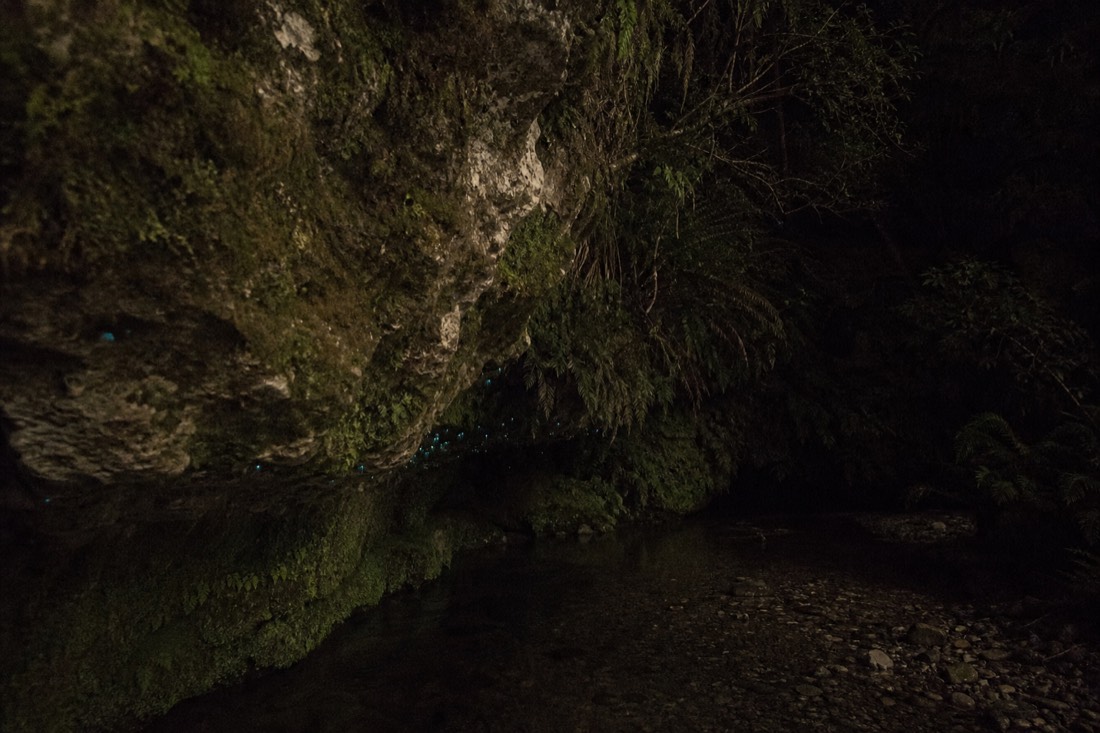
Yes, in bush and on damp banks all over both islands, wherever it is dark and sheltered enough. Arachnocampa luminosa is not confined to show caves. It needs darkness, humidity and something flying below it to catch, which describes a great many New Zealand stream banks after dark.
What a free site cannot give you is density or comfort. A dozen larvae on a bank is a different thing from a ceiling of thousands in a chamber you reach by boat. Both are worth seeing; only one of them is what people mean when they talk about the Waitomo caves.
What Should You Know Before Any Of Them?
That the glowworms have no season, that light and noise both matter, and that photographing them is harder than you think. Glowworms can be seen year-round; the brightness of a particular display and its viewing conditions can vary. Sixteen degrees at Waitomo, in every month.
Light is the reason the main Glowworm Cave bans cameras entirely while Ruakuri and Aranui allow non-flash photography: the larva's glow is bait for its silk fishing lines, and competing light makes the trap useless. The full explanation is worth two minutes before you get annoyed at a rule.
Even where photography is allowed, faint light makes sharp results difficult. Ruakuri’s regular tour prohibits tripods and extension sticks; use only permitted equipment and follow your guide’s instructions. Why phone cameras fail specifically covers the physics.
| Site type | Cost | Density | Photographable |
|---|---|---|---|
| Managed show cave with a boat | NZ$81 to NZ$145 | Highest | Usually not |
| Managed walking cave | NZ$99 to NZ$116 | High | Sometimes |
| Free bush track at night | Nothing | Scattered | With a tripod |
Which Glowworm Tour Has The Best Reviews?
Compare the type of experience as well as its recent reviews. A small-group adventure and a short show-cave boat tour serve different expectations.
| Tour | Useful distinction | Format |
|---|---|---|
| Off the Beaten Track eco cave tour | Active natural-cave exploration | Small group, private cave, 3.5 h |
| The Waitomo Experience, Okohua cave | Wet cave and hot-tub finish | Six guests, 3.5 h |
| Black Labyrinth rafting | Equipment included | Tubing through Ruakuri Cave, 3 h |
| Aranui Cave | Limestone formations | 1 h, no glowworms |
| Waitomo Glowworm Caves | The named Grotto | 45 min, the Grotto by boat |
Read recent reviews for the exact tour you are considering. Compare accounts of pace, terrain and time spent with glowworms; a star score is not a substitute for matching the format to your group.
What Conditions Do You Need For A Good Sighting?
Darkness, damp and stillness. Get those and almost any site works; miss one and the best cave in the country looks empty. Outdoor and underground viewing conditions differ; neither format guarantees a particular brightness or display.
| Condition | Managed cave | Free bush track |
|---|---|---|
| Darkness | Underground viewing setting | Depends on local lighting and conditions |
| Humidity | Stable, controlled | Weather-dependent |
| Stillness | Sheltered underground setting | Exposed to outdoor conditions |
| Density of larvae | Highest at the Grotto | Scattered |
| Your own light discipline | Enforced | Down to you and everyone else on the track |
That last row is the one that ruins free sightings. One person with a phone torch on a bush bridge can dim a whole bank of larvae for everyone standing there, which is exactly the effect the paid caves prohibit cameras to prevent.
Is A Glowworm Cave Worth It If You Have Seen Fireflies?
Yes, because they are not the same phenomenon and they do not look alike. A firefly is an adult beetle flashing to attract a mate, in open air, at dusk, in yellow-green. A glowworm is a fly larva holding a steady blue-green light at around 480 nanometres, on a cave ceiling, in total darkness, to bait a trap.
| Fireflies | New Zealand glowworms | |
|---|---|---|
| The animal | Adult beetle | Fly larva |
| The light | Intermittent flashing | Steady glow |
| Colour | Yellow-green | Blue-green, ~480 nm |
| Where | Open air at dusk | Cave ceilings and damp banks, in darkness |
| Why | Mating signal | Bait for silk fishing lines |
| Effect | Moving points in the air | A fixed field of light overhead |
The visual result is closer to a planetarium than to a summer field. That is the reason the comparison people reach for is a night sky rather than an insect.
What Does Each Format Actually Feel Like?
Very different, even though the animal is identical. Choosing a site is really choosing a format, and the formats are further apart than the map suggests.
| Format | The experience |
|---|---|
| Boat through a dense grotto | Silent, dark, overhead, over in minutes; the postcard |
| Walking cave with glowworms | Closer, longer, and you control where you look |
| Tubing on your back | Glowworms overhead while floating; cold, physical, memorable |
| Small private cave | Time to stand still, and permission to photograph |
| Free bush track at night | Scattered, quiet, entirely yours, weather-dependent |
The boat format is the one people picture and the one that ends soonest. Every other format on that list gives you more time and less density, which is the trade running through this entire district.
Can You See Glowworms Anywhere Outside New Zealand?
Not this species. Arachnocampa luminosa is endemic to New Zealand. Related species in the same genus occur in Australia, and various unrelated bioluminescent insects occur elsewhere, but the specific animal that produces the Waitomo effect lives here and nowhere else.
| Where | What you would see |
|---|---|
| New Zealand | Arachnocampa luminosa, the species in this article |
| Australia | Related Arachnocampa species in some caves |
| Europe and North America | Fireflies, a different animal with a different purpose |
| Southeast Asia | Synchronous fireflies in some mangroves; not glowworms |
That endemism is a large part of why Waitomo became an international name rather than a regional curiosity, and it is a fair answer to anyone asking whether the detour is worth it: there is no closer substitute, anywhere.
Where is the best place to see glowworms in New Zealand?
The Glowworm Grotto at Waitomo, for density and format. It is reached by boat on the 45-minute tour and holds the concentration that made New Zealand's glowworms famous. For a longer, calmer look, Ruakuri or Spellbound. For free, the Ruakuri Bush Walk at night.
Can you see glowworms for free?
Yes. The Ruakuri Bush Walk near Waitomo village is a free 45-minute public circuit with glowworms visible at night near the main bridge, and the species turns up on damp, dark stream banks across both islands. The display is scattered rather than dense.
Are the South Island glowworms different?
Same species, different cave. Te Anau's cave system is about 12,000 years old and still forming, against roughly 30 million years for the limestone at Waitomo, and the tour runs two to two and a half hours including a lake crossing. Waitomo holds the denser colony.
Is there a season for glowworms?
No. Arachnocampa luminosa glows year round and show caves hold a constant temperature, 16 °C at Waitomo. Brightness varies with how hungry an individual larva is, since the light is bait, not with the calendar. Choosing when to go is about crowds.
Can you photograph glowworms?
Not in the Waitomo Glowworm Cave, where all photography is prohibited. Ruakuri and Aranui allow non-flash photography; follow the access and photography rules at each outdoor site. Even where photography is allowed, the faint light makes stable support and longer exposures useful where permitted.
Choose Your Cave Date
Have your island and travel date settled? Check the selected glowworm tour before arranging the rest of your day.
45-minute guided walk and boat ride; allow extra time for check-in. English. Stairs, no wheelchair access and no photography. Meet at Waitomo; transport is not included.
Choose Your Cave And Compare Costs
Which island are you visiting, and do you want a boat ride, photography, adventure, or a free independent walk?
Tour duration excludes your travel and check-in. These are planning suggestions; confirm suitability and your chosen date with the provider.
- Glowworm Cave Walk And Boat
- 45-minute guided walk and boat ride; allow extra time for check-in. English. Stairs, no wheelchair access and no photography. Meet at Waitomo; transport is not included.
- Te Anau Glowworm Caves
- 2 hours 15 minutes including the lake cruise and guided cave visit from Te Anau in the South Island. English, no cameras, not suitable for infants. A different destination from Waitomo.
- Ruakuri Guided Cave Walk
- 90-minute guided walk; allow two hours on site. English, glowworms on foot and photography permitted in designated areas, without tripods or extension sticks. Wheelchair/stroller access up to 65 cm wide; confirm individual needs. Own transport to Ruakuri.
- Off The Beaten Track Cave Tour
- Around 3.5 hours exploring a wild cave with a guide. Phones and small cameras allowed, no professional cameras or tripods. Uneven terrain; unsuitable for mobility, back or heart problems. Meet the operator locally. Minimum age 12, maximum weight 120 kg and moderate fitness required.
- Black Labyrinth Rafting
- Three-hour tubing adventure, with equipment and guide. Minimum age 12 and weight 45 kg; reasonable fitness required. Meet at the rafting base; bring swimwear and towel. No cameras.
Compare Your Group Quotes
Enter two like-for-like quotes in NZD, including transport and extras.