Why Your Phone Cannot Photograph Glowworms
Even where cameras are allowed, the shot can be difficult. A faint blue-green point source at 480 nanometres against black rock is close to the hardest thing a phone can be asked to do.
 Written with Hemi Williams, Waitomo cave guide and local specialist, guiding since 2015
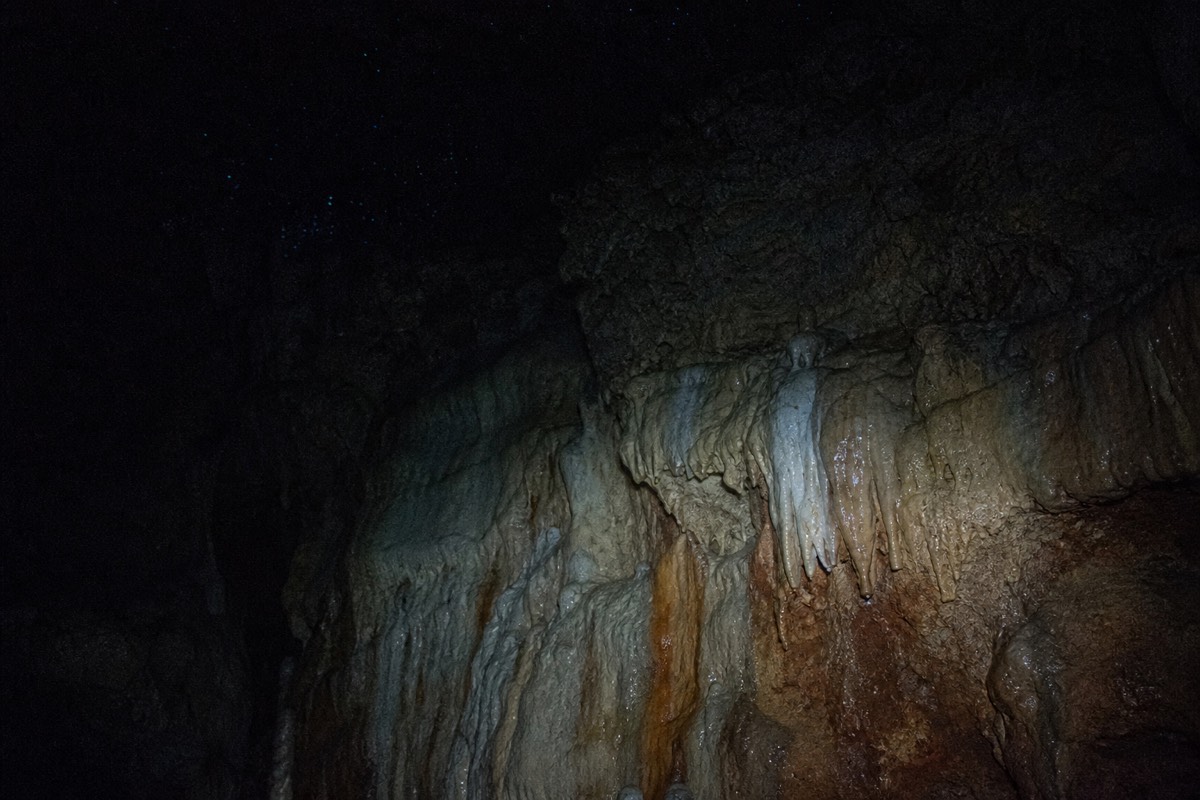
A reviewer on the GetYourGuide listing wrote that "there are some places that photos simply can't capture" and the Waitomo caves are one of them. People read that as sentiment. It is closer to a technical specification, and it holds even at the caves where photography is permitted and you have brought a real camera.
Why Can You Not Photograph Glowworms With A Phone?
Because the light is faint, blue-green, point-sourced and completely surrounded by black. A phone camera resolves that by pushing exposure and ISO until the noise floor is louder than the signal, which turns a ceiling of stars into a grey rectangle with speckles in it.
The glow peaks at around 480 nanometres and is produced by an animal that hangs up to about 30 silk fishing lines and lights itself as bait. The chemistry behind it evolved for a midge, not a sensor: it is not designed to be seen from twenty metres by something the size of a fingernail. It is designed to be seen by a midge from thirty centimetres.
| The problem | Why the phone loses |
|---|---|
| Very low light level | Requires exposures of seconds; the phone assumes you cannot hold still |
| Point sources on black | Autoexposure meters the black and blows out the points |
| Blue-green at 480 nm | Sits awkwardly for sensors tuned for daylight colour |
| You are on a moving boat | Any exposure long enough to work will smear |
| No focus reference | Autofocus hunts and fails in near-total darkness |
The conditions the shot needs against the conditions the tour provides.
| Needed | Available on the tour |
|---|---|
| A tripod | No, you are in a boat |
| An exposure of tens of seconds | No, the boat is moving |
| A large sensor and manual control | Not permitted inside at all |
| Time to compose | 5 to 10 minutes total, in silence |
What Would It Actually Take?
A tripod, a real sensor and an exposure measured in tens of seconds. Cave and astrophotography solve this problem the same way: fix the camera, open the shutter for a long time, and accept that anything that moves will not be in the picture.
None of those conditions exist on the Waitomo tour. You are on a boat being pulled by hand through the dark, with a published boat maximum of 23 people, on a section that lasts perhaps five to ten minutes. Even if the rules allowed it, the physics would not.
Where a tripod is possible is outdoors. The Ruakuri Bush Walk is a free 45-minute public circuit about 2 kilometres from Waitomo village, with glowworms visible at night near the main bridge and equipment use subject to current track rules. That is the realistic place to try. What else there is around Waitomo has the details.

So Is The Camera Ban Actually Costing You Anything?
Less than it feels like it is, and that is worth knowing before you get annoyed at the shelf by the entrance. The rule exists because light competes with the larvae's own glow and makes their traps useless, which is the full explanation and a good one.
But even at Ruakuri, where non-flash photography is permitted and the tour runs 90 minutes on foot rather than five minutes in a boat, image quality still depends on conditions and equipment. Ruakuri is the better cave to try, absolutely, and the comparison covers what else changes. It is not a guarantee of a photograph.
The practical distinction is between permission to take a photograph and a guarantee of a usable image. The boat tour is a viewing experience, not a photography session.
What About The Souvenir Photo?
Green screen, composited, and reviewers do not rate it. Because cameras are banned, the operator photographs visitors at the visitor centre and drops them into a cave image afterwards. One Viator reviewer described paying around US$25 for "an unrealistic picture of the cave" and said she would not recommend it.
That reaction is consistent enough to count as the consensus. Nothing obliges you to buy it, and the full price breakdown lists it among the extras alongside the café.
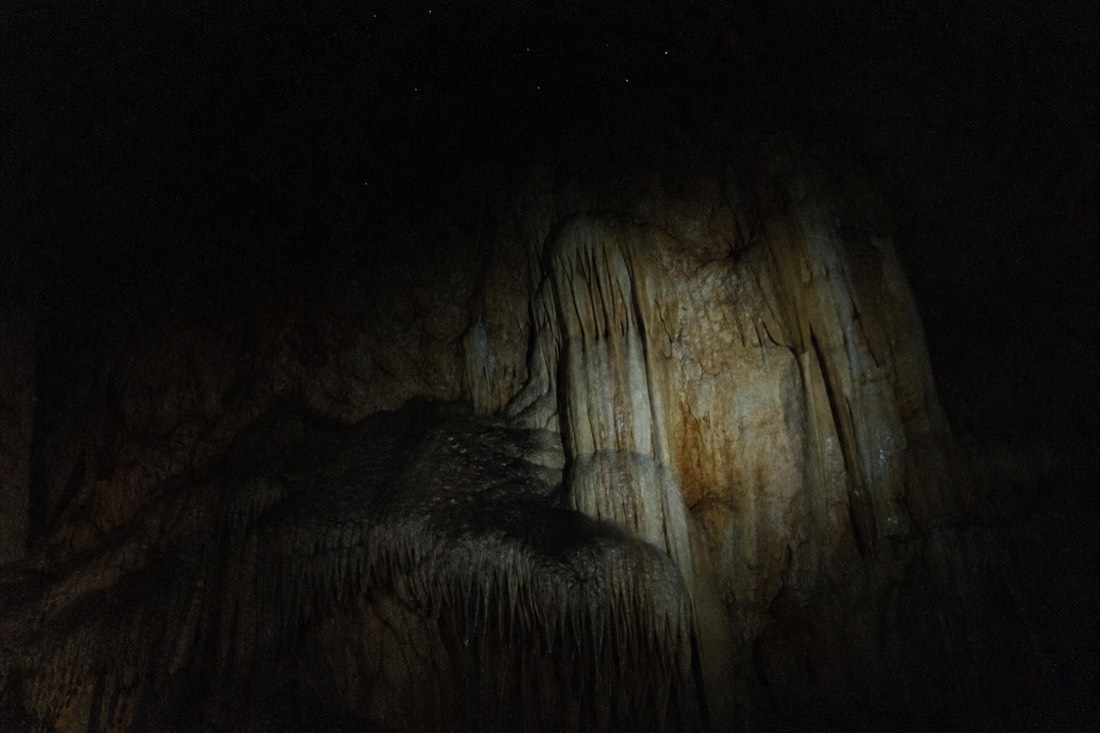
Where a photograph is actually achievable, if you want to try.
| Where | Photography | Realistic with a tripod? |
|---|---|---|
| Waitomo Glowworm Cave | Prohibited | No |
| Ruakuri Cave | Allowed, no flash | Tripods prohibited on the regular tour |
| Ruakuri Bush Walk at night | Follow current track rules | Yes |
What Should You Do Instead?
Look at it, and stop trying. This sounds like a platitude and is actually the practical recommendation, because the alternative is five minutes of fumbling in the dark for an image you will delete.
The reviews are unusually consistent on this point. The people who describe the Grotto most vividly are the ones who gave up on documenting it: "drifting silently beneath thousands of tiny glowing lights felt like looking up at a sky full of stars underground". Nobody writes that sentence while checking an exposure.
If you want the attempt anyway, do it outdoors at Ruakuri Bush Walk with a tripod, for free, on a night you are staying nearby. Where the 45 minutes actually go sets out what you will be looking at.
What About The Newer Computational Night Modes?
They help in low light and they do not solve this. Night modes work by stacking several frames and aligning them, which needs two things a glowworm cave does not supply: enough signal to align on, and a stationary subject relative to the camera.
| Night mode assumes | The Grotto delivers |
|---|---|
| Some ambient light to work with | Effectively none |
| Recognisable edges to align frames | Point sources on black; nothing to lock onto |
| A steady camera over several seconds | A boat moving through the dark |
| A subject that stays put | Fixed ceiling, moving viewer |
| A few seconds to capture | You have minutes, in total silence |
The result is a grey rectangle with speckles, which is what the phone does when it decides noise is better than nothing. None of this is a criticism of the phone; it is the wrong tool being asked to do the wrong job.
Why Do The Professional Photographs Look Like That?
Tripods, long exposures, and often a great deal of time in a cave with nobody else in it. Published glowworm images can come from different equipment, access arrangements and exposures, and comparing your own attempt against them is comparing two entirely different situations.
| Published images | A visitor on a tour |
|---|---|
| Tripod on a stable surface | A moving boat |
| Exposures of tens of seconds | Seconds at most, handheld |
| Large sensors, fast lenses | A phone sensor |
| Access outside tour hours | 45 minutes with a group |
| Multiple attempts across nights | One pass |
| Permission arranged separately | Photography prohibited entirely |
Knowing that in advance is worth more than any technique tip. A published image does not establish what you can capture during your own visit, and the reviewers who describe the Grotto best are the ones who worked that out early.
Can you photograph glowworms with a phone?
Results vary. The light is faint, blue-green at around 480 nanometres, point-sourced against black rock, and needs exposures measured in seconds. A handheld phone on a moving boat is poorly suited to the conditions, and even a stationary one struggles without a tripod.
Which Waitomo cave allows photography?
Ruakuri and Aranui both permit non-flash photography. The Waitomo Glowworm Cave prohibits it entirely, including phones, video and GoPros, with equipment rules set by the operator.
What equipment would actually work?
A tripod, a camera with a large sensor and manual control, and an exposure of tens of seconds, which is how cave and astrophotography handle the same problem. None of that is compatible with a moving boat on a five-minute section.
Where can you try photographing them?
The Ruakuri Bush Walk, a free 45-minute public circuit about 2 kilometres from Waitomo village, where glowworms are visible at night near the main bridge where you must follow current track and equipment rules.
Is the souvenir photo worth it?
Reviewers say no, consistently. It is shot against a green screen at the visitor centre and composited into a cave background, and travellers describe the result as unrealistic. It is reported at around US$25 and is entirely optional.
Choose Your Cave Date
Have a travel date in mind? Check Ruakuri Guided Cave Walk before arranging the rest of your day.
90-minute guided walk; allow two hours on site. English, glowworms on foot and photography permitted in designated areas, without tripods or extension sticks. Wheelchair/stroller access up to 65 cm wide; confirm individual needs. Own transport to Ruakuri.
Choose Your Cave
Is photography permission, the iconic boat, or a rugged cave route your priority?
Tour duration excludes your travel and check-in. These are planning suggestions; confirm suitability and your chosen date with the provider.
- Ruakuri Guided Cave Walk
- 90-minute guided walk; allow two hours on site. English, glowworms on foot and photography permitted in designated areas, without tripods or extension sticks. Wheelchair/stroller access up to 65 cm wide; confirm individual needs. Own transport to Ruakuri.
- Glowworm Cave Walk And Boat
- 45-minute guided walk and boat ride; allow extra time for check-in. English. Stairs, no wheelchair access and no photography. Meet at Waitomo; transport is not included.
- Off The Beaten Track Cave Tour
- Around 3.5 hours exploring a wild cave with a guide. Phones and small cameras allowed, no professional cameras or tripods. Uneven terrain; unsuitable for mobility, back or heart problems. Meet the operator locally. Minimum age 12, maximum weight 120 kg and moderate fitness required.